
Glenorchy
Tasmania 7010 Australia
Phone: 61 3 62497868 (am)
Phone: 61 3 62713000 (pm)
Fax: 61 3 62730010
www.tececo.com
| |
497 Main Road Glenorchy Tasmania 7010 Australia Phone: 61 3 62497868 (am) Phone: 61 3 62713000 (pm) Fax: 61 3 62730010 www.tececo.com |
 Printed in cyberspace on recycled electrons
Keeping you informed about TecEco sustainability projects. Issue 55, 25 February, 2006
LONDON * The world must halt greenhouse gas emissions and reverse them within two decades or watch the planet spiraling towards destruction, according to scientists.
Saying that evidence of catastrophic global warming from burning fossil fuels was now incontrovertible, the experts from oceanographers to economists, climatologists and politicians stressed that inaction was unacceptable.
"Climate change is worse than was previously thought and we need to act now," Henry Derwent, special climate change adviser to British Prime Minister Tony Blair, said at the launch of a book of scientific papers on the global climate crisis.
Researcher Rachel Warren from the Tyndall Centre for Climate Change Research,
who contributed to the book "Avoiding Dangerous Climate Change", said
carbon dioxide emissions had to peak no later than 2025, and painted a picture
of rapidly
approaching catastrophe.
Global average temperatures were already 0.6 Celsius above pre-industrial levels, and a rise of just 0.4C more would see coral reefs wiped out, flooding in the Himalayas and millions more people facing hunger, she said.
A rise of 3C -- just half of what scientists have warned is possible this century -- would see 400 million people going hungry, entire species being wiped out and killer diseases such as dengue fever reaching pandemic proportions.
"To prevent all of this needs global emissions to peak in 2025 and then come down by 2.6 percent a year," Warren said. "But even then we would probably face a rise of 2 degrees because of the delay built into the climate system. So we have to start to plan to adapt," she added.
Already the effects of the change are becoming visible, with more extreme weather events and people in coastal areas put at risk from rising sea levels due to melting ice caps.
The first phase of the global Kyoto protocol on cutting greenhouse gas emissions runs until 2012, and negotiations have only just started on finding a way of taking it beyond that.
The United States, the world's biggest polluter, has rejected both the protocol in its current form and any suggestion of expanding or extending it. Instead it has set up with Australia, India, China, Japan and South Korea the Asia Pacific Partnership on Clean Development.
Source: Reuters
Humanity has unprecedented powers to damage planet earth and affect the well-being of present and future generations. Few people realise the extent to which existing technical paradigms driven by fossil fuels are causing havoc. At TecEco we believe that in order to live more sustainably we need to make our economic consumption behaviours work for the planet, instead of against it. We can do this by changing the technical paradigms of our many industries. Technical paradigms define what energy and matter are valued as resources and what is emitted or discarded as a waste and thus the underlying molecular flows that are so damaging.
Cultural change has increased the demand for more sustainable products. To meet this increasing demand new innovative technical paradigms are evolving. The Gaia Engineering Geo-Photosynthetic Industrial Process (formerly CarbonSafe) is not a single process or paradigm but a tececology which embraces a number of new technical paradigms and processes designed to solve global warming and waste problems by changing the flows involved. Gaia Engineering will work because combined correctly these new processes will allow people to make money using them.
If adopted on a large scale the Gaia Engineering process would sequester significant amounts of atmospheric CO2 and convert significant wastes to resources. Gaia Engineering is an agglomeration of new technologies including TecEco’s kiln technology and cements, carbon dioxide scrubbing technology, a seawater separation technology from Greensols Pty. Ltd and heat at transfer and desalination technologies that can produce fresh water, a number of industrial commodity products including gypsum, sodium bicarbonate and various other salts as well as building materials based on magnesium carbonates that also utilize wastes. Each of these outputs uniquely provides revenue to help make the overall process economic.

The Gaia Engineering process starts with either magnesium silicates or the Greensols process. In the case of silicates, magnesium carbonates are produced using proven mineral sequestration technology and then transferred to the MgCO2 cycle. The Greensols process on the other hand uses carbon dioxide from power stations and waste acid to extract magnesium carbonate and other salts from seawater or suitable brines and producing potable water as a by-product. The MgCO3 from either process is then calcined in the TecEco kiln which removes and captures carbon dioxide (ready for incorporation for example into cellulose or fuel or other compounds or for geo-sequestration) and produces magnesium oxide. The magnesium oxide can either be used to make TecEco cements which utilize other wastes and in the case of Eco-Cement absorb more atmospheric CO2 as they harden or alternatively used to sequester more CO2 in a hydroxide/carbonate slurry capture process.
The carboantes produced by the hydroxide slurry process can be decarbonated and cycle around that process indefinitely as in the diagram below.

Technologies are still evolving to use the CO2 produced by Gaia Engineering (formerly CarbonSafe) process. A particular future use of CO2 that we are monitoring is to force rapid growth of genetically modified algae able to convert CO2 and water into oxygen and cellulose or oxygen and fuel.
The MgCO2 and hydroxide/carbonate slurry process cycles mimic photosynthesis using the same central atom (magnesium). They can
go around and around like a bicycle wheel as together, mass and energy are neither
created nor destroyed, only lost outside the system through inefficiencies.
There is an exothermic part of the MgCO2 cycle where heat is required and an endothermic
part where heat is released. To make the process as efficient as possible it
is desirable to capture the heat from the exothermic parts and as efficiently
as possible transfer it to the endothermic parts of the cycle.
The efficiencies of the various sub-processes are fundamental to making the Gaia Engineering process economic and minimizing the amount of energy required overall. An important area of research we are engaged in is to develop technologies for the efficient collection, concentration and transfer of heat energy and more follows about this (See Transferring Heat from the Exothermic Part to the Endothermic Part of the MgCO2 Cycle).
We call Gaia Engineering a geo-photosynthetic process because it mimics the way that plants, algae and some bacteria capture and store carbon using photosynthesis. In 1796, Jean Senebier, a French pastor, showed that CO2 was the "fixed" or "injured" air and that it was taken up by plants. Soon afterwards, Theodore de Saussure showed that the increase in mass of the plant as it grows could not be due only to uptake of CO2, but also to the incorporation of water.
It followed that the process of photosynthesis achieves the following:
CO2 + H2O + light energy ---> (CH2O)n + O2
Basing our industrial ecologies on Gaia Engineering will result in sustainable cities
that store carbon and are constantly recycled.
.

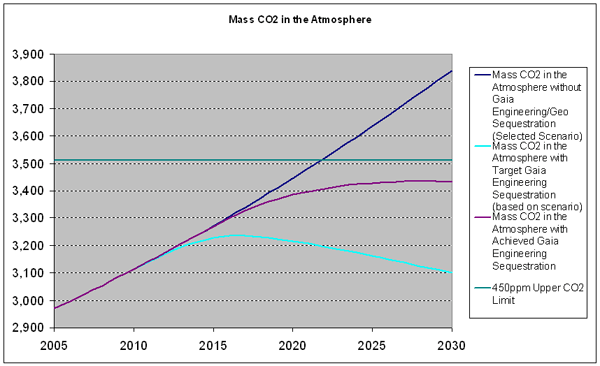
TecEco have developed an Excel model of the Gaia Engineering process to work out the plant and process requirements to sequester enough CO2 to avoid reaching a concentration of 450 parts per million in the atmosphere, considered by many as an upper limit to avoid the most dangerous effects of global warming and irreversible change. It relies on several assumptions, including a forecast for magnesia sales for use in concrete and the extent to which global abatement programs will be successful,. Outputs include the number of plants of a given capacity that will be required as well as the costs and revenues involved in running the process. If you would like to review the model please go to the TecEco web site and look under tools.
In a continuous cyclic process such as the magnesium thermodynamic cycle component of Gaia Engineering (dubbed the MgCO2 cycle) it is important to be able to transfer the heat produced in the exothermic parts of the cycle to the endothermic calcining part or at least transform it into a useful form such as electricity with minimal losses.
There are several exciting new technology contenders for capturing low grade heat including a pyroelectric process being promoted by CANMET in Canada and various modified liquid/vapour pressure processes including the Newcomen engine and non water Rankine engines. As the liquid used in the latter is normally an organic compound they are often referred to as Organic Rankine Energy Cycle engines or ORCE’s. The Newcomen engine is particularly attractive to TecEco as one of the outcomes is potentially the production of potable water.
Power stations waste a lot of low grade heat and should consider retrofitting Newcomen engine technology discussed below.
Edited from material supplied by Bill Courtney, Cheshire Innovation at http://www.cheshire-innovation.com
The Newcomen engine concept presented by TecEco and Cheshire Innovation follows from the original steam engine invented around 1712 by Newcomen and is named after him. With the application of modern technology heat exchangers, condensers pumps, turbine technology and a few other ‘smarts’ Newcomen engines are potentially very efficient at capturing low grade heat and condensation pressure differentials and converting them to higher value forms of energy such as electricity.
In the Gaia Engineering process this energy can then be
sold, used to power pumps and motors or transferred to our tec-Kiln on the endothermic
side of the MgCO2 cycle.
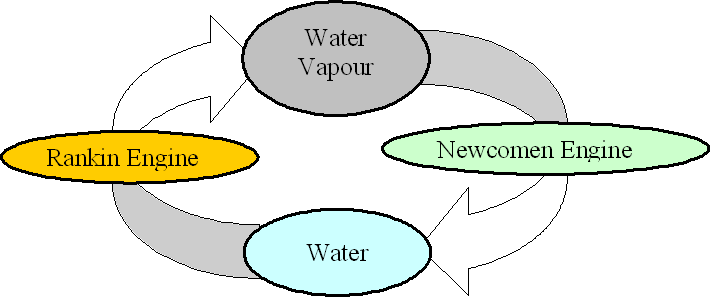
In contrast to Rankine cycle engines Newcomen engines capture the pressure change and heat released in the transition from a vapour back to a liquid. Newcomen engines can be retrofitted to existing fossil fuel and nuclear power stations and as a bonus produce distilled water.
The world's resources of low grade heat, both natural and man-made far exceed our energy requirements. To date, these resources have been disregarded, because low grade heat cannot efficiently be used to drive conventional turbine generators. Newcomen engines utilise the large volume differences when water vapour collapses to form a liquid. Low grade heat can be used in contrast to the high grade heat required to create the necessary excess gas pressures to drive steam turbo-generators. The basic idea is not new as in the table below
| EARLY "ATMOSPHERIC" STEAM ENGINES E.G. NEWCOMEN'S MINE ENGINE 1712 | FOSSIL FUEL and NUCLEAR BASED MODERN STEAM ENGINES | MODERN NEWCOMEN ENGINES | |
| THE KEY IDEAS BEHIND HOW THEY WORK | The collapse in volume and pressure caused by steam at atmospheric pressure condensing into water can be harnessed as useful mechanical work | The steam is raised to a very high temperature. A large fraction of the collapse in volume and pressure takes place prior to condensation | Go back to the early "atmospheric" steam engine concept but include new designs of heat exchangers to capture the latent heat |
| THEIR THERMAL EFFICIENCY PROBLEM | Large amounts of latent (hidden) heat are liberated as low grade thermal energy. The early engines were only about 2% efficient | At least 50% of the energy used to heat the steam is still wasted because latent heat must be given up, when the steam condenses | Any heat engine incurs energy losses, but by minimising latent heat losses, high levels of efficiency can be achieved |
The figure below illustrates the basic concepts behind a solar energy powered Newcomen engine generator system. To reduce the visual clutter, the thermal feedback loop has been omitted.

Newcomen engine generator systems require two physically separated masses of water vapour. Primary vapour is generated in a large evaporation chamber. When it collapses, on cooling, inside the turbo-generator, electricity is generated. Secondary vapour is generated inside the turbine, when latent heat is extracted from the primary vapour.
In the next figure below, brine in the evaporation chamber is heated:
Fresh brine is continuously added at the cold end of the trough, with hot, concentrated brine being drawn off at the hot end. The heat stored in the concentrated brine is re-cycled, to pre-heat the turbine cooling water.
At the cool end of the condensation chamber, the secondary vapour always ends up transferring its latent heat to the overlying brine, because the vapour pressure builds up until it reaches its dew point.

In order to re-cycle the heat stored in the secondary vapour at the highest possible temperature, the latent heat in the primary vapour needs to be drawn off in several fractions. The figure below shows a vertical cross section through a turbo-generator that draws off the secondary vapour in three fractions.

In the first figure, the primary vapour is pulled through the rotor by a suction process. In the figure above this is converted into a push process, by cooling the primary vapour, before it hits the first rotor.
How the push process works
Engineers familiar with steam turbine design will spot two other design features:
The figure below shows how a single condensation chamber under the evaporation chamber, can accept several fractions of secondary vapour, at different input temperatures.

A second water distillation circuit can be built into the Newcomen Generator design by using brine as the cooling water inside the turbine unit. The water distillation process consumes a negligible amount of energy compared with running the system using fresh water (Some energy is consumed in delivering fresh brine to the system and pumping away concentrated brine)
Because brine is corrosive the capital cost of building a power plus drinking water generator will be higher than for a system running on fresh water. The costs can however be recouped by selling the drinking water in regions where it is a scarce commodity.
Newcomen generators could also be used for other distillation processes such as, for example, the separation of alcohol from water, following fermentation.
There are several thousand miles of desert coastline throughout the world. If Newcomen Generators are used to generate fresh water to green the desert, then a surplus of electricity will be produced. This spare capacity could be used to liberate hydrogen from sea water. The hydrogen could be exported and used as power station fuel, instead of natural gas.
If hydrogen fuel cells ever become economically viable, hydrogen from solar powered Newcomen Generators could be used to split water electrolytically as the primary hydrogen supply.
Existing fossil fuel and nuclear power station systems that incorporate steam turbo-generators are less than 50% efficient. They dump at least half of the energy they consume back into the environment as waste heat. By using Newcomen systems similar to those described above to capture the waste heat, the wastage could be minimised. The figure below shows a compact design of an evaporation plus condensation chamber for use with fossil fuel and nuclear power stations.

In many industrialised countries, including the UK, France, Germany and the USA, approximately one third of fresh water usage is accounted for in cooling power stations, with the resultant warm water vapour emitted by cooling towers being dumped into the environment. By using the waste heat productively, to drive Newcomen generator systems, even fresh water Newcomen generators will contribute significantly to preserving fresh water.
Carbon capture systems extract the carbon dioxide from fossil fuel power station flue gases, compress the gas for ease of transportation and bury it deep underground, for example in depleted oil reservoirs. The compression process is wasteful when used with conventional power station systems because compression generates low grade heat that must be disposed of. In contrast, Newcomen generator systems are designed to work using low grade heat, so by combining a Newcomen generator with a suitably designed carbon capture plant the capture process can be made more cost effective. The figure below shows a notional plant design, with the turbines described earlier, being replaced by compressors.

The essential argument made in the above figure is that by incorporating an alternating series of compression pumps and heat extraction units, Newcomen Generator systems can be used for energy efficient carbon capture.
The pressure drops caused by the condensing out of the carbon and sulphur dioxides could be used to drive turbo-generators similar to those described previously.